Information for International Students | Working in the US
Optional Practical Training (OPT)
According to the U.S. Citizenship and Immigration Services (USCIS), formerly the INS, students with F-1 visas who have completed at least one year of full-time academic study are eligible to work full-time for 12 months. Optional Practical Training (OPT) must be directly related to a student's academic major and can be used prior to or after graduation for a paid internship, part-time job and/or full-time position. If you choose to obtain an unpaid volunteer and/or internship position, you are not required to apply, or use, any portion of your OPT.
H-1B Visa
If an employer wishes to hire a foreign national employee following his/her OPT, the employer may be able to sponsor the individual for an H-1B visa, or temporary worker status. The foreign national must have at least a Master’s degree or its equivalent in a particular field, and this degree must be a requirement for the job. However, an employer does not have to provide proof that the foreign employee is unique in his/her industry. To obtain an H1-B status for a foreign employee, an employer must file a petition with the USCIS. This process can take anywhere from two weeks to five months to complete, so an employer should submit the application approximately six months before an employee's OPT expires. An H-1B visa permits a foreign national employee to work an additional one to six years in the U.S.
For information on employers who have submitted sponsorship applications to the Department of Labor, log onto the Pride Career Management System and on the “home” page, click on “Suggested Website for You” and access “Washington Information Services” (www.h1visajobs.com) using the access codes.
Hiring Foreign Nationals
When an employer makes a hiring decision, he/she does so with the hope that this new employee will devote several years to the position and company. It is very costly to hire and train a new individual; therefore, employers are often reluctant to interview or hire international students because of restrictions on length of employment.
Some employers, however, may be convinced to change their policies if given a clear understanding of the process to "sponsor" a foreign national on an H-1B visa. In order to properly educate an employer, it is imperative that you clearly understand the process yourself.
You must have complete, current and accurate knowledge of your options and both your, and the employer's, responsibilities.
You must also be able to clearly explain the process to an employer so that he/she does not see sponsorship as an obstacle in the hiring process.
While the employer must legally pay the majority of the H-1B visa filing fee, you may offer to pay for all attorney fees and any additional costs associated with the H-1B filing process.
To review this process in greater detail, meet with an advisor in the Office of Multicultural and International Student Programs early and often, as regulations may change.
Cultural Differences in the Job Search
|
United Stated Employment Expectations |
International Employment Expectations |
|
|
|
|
|
|
|
|
|
|
|
|
The key to gaining work experience in the United States is to PLAN AHEAD!
Communication Skills
Excellent communication skills, both verbal and written, are at the top of the list of employer expectations. You should be fluent in English, as you will be expected to communicate clearly with your co-workers, clients and supervisors. To strengthen your communication skills, speak English as often as possible - in your home, with your friends and at your job. Take a public speaking class to develop your presentation skills and read newspapers on a regular basis.
Unique Skills
Since many employers are reluctant to interview or hire international students, you must be able to confidently discuss your strengths and skills and how they will benefit the industry/company. You can start by learning anything and everything about your industry and the companies to which you will apply. Find out what skills and qualities are in demand and decide if and how you have developed these same skills and qualities.
Focus on your bilingual abilities, unique cultural background, knowledge of overseas economies and business practices and adaptability to new environments and cultures. This self-knowledge will make a lasting impression on an employer.
Resume
This will be the first evidence of your written communication skills. Make sure your resume is well written, reflects your accomplishments and has perfect grammar and spelling. We highly recommend you meet with the Graduate Business Career Services office to prepare an effective resume. Some tips include:
Provide more details on foreign companies you worked for and foreign schools attended, i.e. How large was the company? What do they do? What is the company's products or services? How large was your school?
- Emphasize your strong English skills
- Review how to construct a resume - access Vault or Resonate through Pride CMS on the MyHofstra Portal
- Learn how to write an effective cover letter - access Vault or Resonate through Pride CMS on the MyHofstra Portal
- After updating your resume, schedule an appointment with a Career Advisor a for a resume and cover letter critique by calling 516-463-6060
Interviewing Skills
The job interview will be your first opportunity for an employer to witness your verbal communication skills. Review interview practices for various industries and positions by accessing Big Interview through Pride Career Management System on the MyHofstra Portal. It is also suggested you improve your interviewing skills in a practice interview by meeting with a Career Advisor or Alumnus so you make a great first impression
- Practice your eye contact and handshake
- Express your skills confidently
- Use examples of your accomplishments and how you developed your skills.
- Review additional Interviewing Skills
Networking
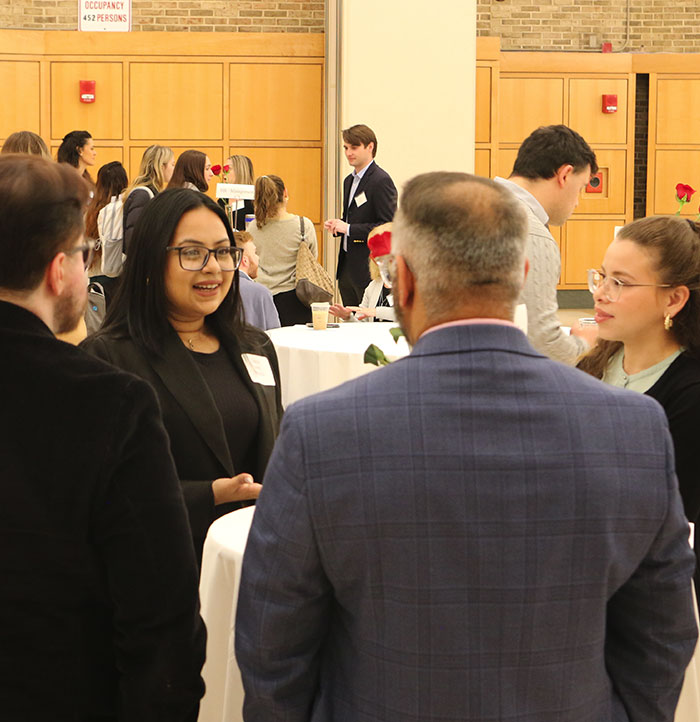
Of all jobs available at a given time, only approximately 20% are ever advertised. The remaining 80% are found through networking. Make sure you understand this process and use it daily, beginning many months before you want to start working.
Networking is reaching out to friends, family, classmates, faculty, co-workers and anyone with whom you come in contact to gather information about industries, companies and opportunities. Networking is asking for information and advice, not a job.
Please see our Professional Networking page to find out more about avenues for networking.
Obtaining an Internship
Internships help you gain valuable work experience related to your field of study and introduce you to American employers. If you make a great impression on an employer during this experience, your supervisor may be more willing to hire you full-time once you graduate.
- Paid internships do count toward your Optional Practical Training.
- Be sure to contact Graduate Program Office first to see if you are eligible to apply and obtain the Chairperson’s approval. Once you have been approved to accept an internship, you will then make an appointment with the Office of Multicultural and International Students Programs to complete your paperwork.
- Learn more about available internships by accessing Pride CMS and also viewing our website for additional website links.
Additional Tips and Techniques
Searching for a job is a time consuming task. In addition to the methods discussed above, there are several job search methods that should also be used for the most effective results.
- Utilize your embassy located here in the U.S.
- Review related Job Search links available on our web site.
- Concentrate on employers who have offices, plants, subsidiaries or sales forces in your home country.
Disclosing Your Visa Status
Employers have a high regard for honesty, so you will want to discuss your visa status with them at some point in the job search process.
When is the best time? Opinions vary, but we feel it is best to discuss your status after you have had the chance to make a positive impression on the employer. This could be at the end of the first interview or during the second interview.
Before an interview, be sure you are comfortable discussing your Optional Practical Training as well as H-1B options. This will be your only opportunity to convince the employer that you are a great match for the position and that sponsorship is a simple process.


YouTube FourSquare Flickr RSS