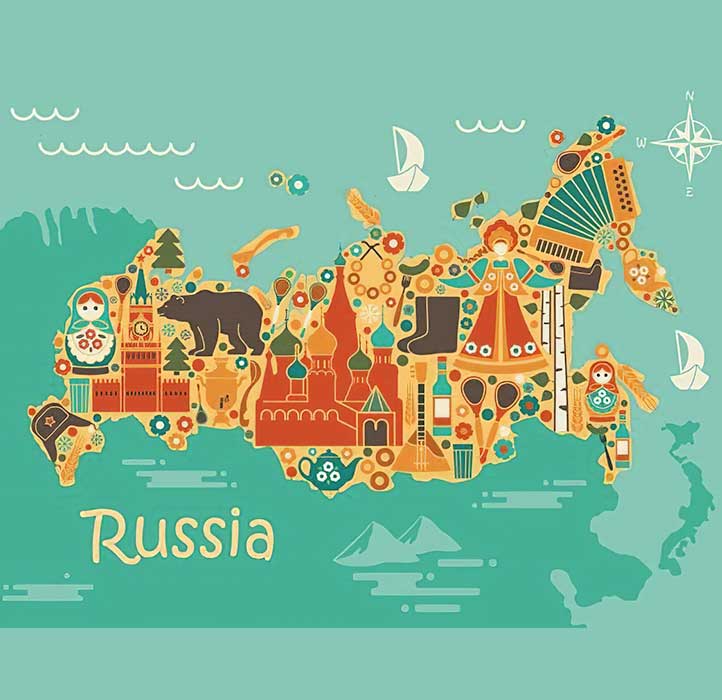
The Russian and Post-Soviet Studies Program at Hofstra is a small, particularly active and close-knit group of students and faculty. The major emphasizes Russian language, literature, history, and film in order that students develop a broad understanding of this extraordinarily rich culture in the past and present.
- Russian is classified as a critical language by the U.S. State Department, meaning Russian students are eligible for special funding and educational and career opportunities.
- Russian speakers and experts on Russian culture and society are in high demand in the U.S. today, in fields such as business, government, security studies, law, and diplomacy.
- Russian is spoken by 280 million people worldwide and is the lingua franca throughout the countries of the former Soviet Union and much of Eastern Europe.
- Russia is the largest country on the planet, stretching from Europe through Asia. A train trip from Moscow in the west to Vladivostok in the east takes seven days and passes through eight time zones.
- Russian writers, artists, composers, dancers, and musicians have created many of the world’s greatest masterpieces.
- From Ivan the Terrible and Peter the Great to Lenin, Stalin, and now Putin, Russia has produced political leaders who have changed the course of history.
Our Russian language classes aim at practical application that will help you to communicate successfully in any country where Russian is spoken. It takes just a week to learn the Cyrillic alphabet, after which studying Russian is like studying any other world language. RUS001 is for true beginners. If you already know some Russian, you will be placed in the proper section: just reach out to Dr. Pustovoit for advisement. We make sure every student gets the right placement.
Our Russian literature and culture classes are open to everyone: You need no prior experience. We read classical and contemporary Russian literature in translation; Russian-speaking students can elect to read texts in the original and discuss them in small group settings. These discussion-based literature and culture classes cover a broad range of topics such as history, politics, religion, film, theater, music, and aspects of daily life. None of our LIT courses require any previous knowledge.
Taking Russian Studies courses, minoring in Russian Studies, or majoring in Russian Studies will not only help you understand the legacy of the Russian Empire and the Soviet Union, but will help you navigate the complexity of contemporary global processes. It will make you ponder the eternal questions. Challenge yourself!
For questions, contact the Russian program advisor, Dr. Pustovoit, or the chairperson of CLLL Department, Dr. John Krapp.