Skip to content
Print this page

Facilities

Over the summer Weed Hall, home to the Engineering Department, underwent $4 million in renovations. The laboratories and classrooms now have new technologies, machinery, and equipment, all of which are accessible to undergraduate engineering students.

  • 016 – Electrical and Signal Processing Laboratory

    This laboratory is used for the teaching of introductory and advanced level electrical engineering concepts, including the design of electronic and digital circuits.  All engineering students utilize this lab in their introduction to electrical engineering through hands-on instruction in oscilloscope use, transient and steady-state analysis, and the design of operational amplifiers.

    • Digitized Oscillisopes with Spectrum Analyzers
    • Digitized Function Generators
    • Digitized Power Supplies
    • Digital Circuit Design and Microcontroller Boards
    • Computers for Data Acquisition and Computer Aided Design (CAD)
  • 014 – Materials Lab

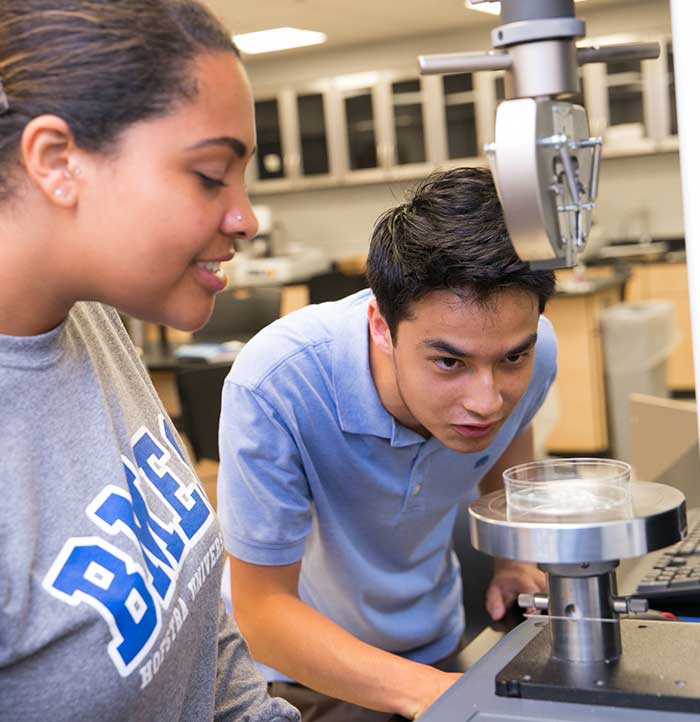
    This laboratory is utilized by all students in the civil and mechanical engineering programs in a laboratory course on the experimental determination of the properties of engineering materials.  The laboratory equipment is used to apply axial, flexural, and torsional stresses to test samples as well as non-destructive testing of materials.

    • Tinius Olsen testing machines (one large frame, one small frame)
    • Heat treatment furnace
    • Com-ten bench-top materials test stand
    • Rockwell hardness tester
    • Metallurgical sample preparation equipment
    • Metallurgical microscope
  • 011 – Fluids Engineering Lab

    In this laboratory, mechanical engineering students perform experiments in fluid mechanics.  The subsonic and supersonic wind tunnels as well as the water channel and water table are used for hands-on instruction in laboratory experiments.

    • Low turbulence subsonic wind tunnel and Mach 3.2 supersonic wind tunnel (with data acquisition)
    • Water channel for open channel hydraulics
    • Water table for flow visualization and shock simulation
  • 020 – Civil/Environmental Engineering Lab

    This laboratory is used for instruction and experiments in the environmental engineering component of the civil engineering program.  In the lab, the measurement of engineering properties of soils and for examining the selected environmental treatments for water and wastewater.

    • Sieve Shaker
    • Proctor compaction apparatus
    • Hach Spectrophotometer
    • Incubators
    • Armfield Aerobic digester
  • 208 – Cell and Tissue Engineering Lab

    Our lab contains the following equipment... | more |

  • 022 Adams – Thermal Engineering Lab

    This laboratory is used for instruction of mechanical engineering students in the design of systems that produce power or refrigeration.  Laboratory experiments are designed for applying the theories of thermodynamics and thermal engineering with thermal and energy equipment.

    • Heat exchangers
    • Air conditioner design testing unit
    • Heat pump
    • HVAC design tools
  • 106 – Engineering Computer Lab

    This laboratory is used for the instruction of specific engineering-based software packages.   When the laboratory is not being utilized for instruction, it serves as a general computer laboratory for all engineering students.

    • 40 work stations
    • Software includes: AutoCAD
      • MatLab
      • Comsol
      • STAAD
      • Other engineering design software
  • 012 Adams – General Engineering

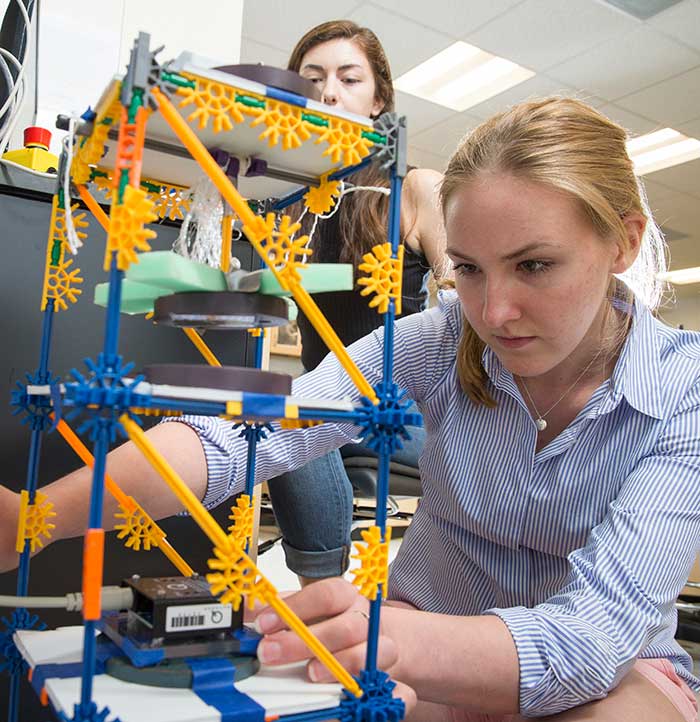
    This laboratory is used for teaching of the lab sections of ENGG15: Designing the Human Made World.  Students in the course meet in teams weekly in the lab and perform hands-on design experiences.  These design experiences culminate at the end of each semester in the grand design challenge, a team-based design competition.

Hofstra University Cell and Tissue Engineering Lab

Our lab contains the following equipment:

HR-1 Discovery Rheometer – Demo Model, HR-2 Discovery Rheometer
HR-1 Discovery Hybrid Rheometer DEMO Model: Discovery Hybrid Rheometer represents the latest technological breakthroughs from the world’s leader in rheology.  It combines a patented drag cub motor, a second generation magnetic bearing, force rebalance transducer technology (FRT), and True Position Sensor (TPS) into a single-head rheometer.  The HR-1 model offers a torque range of 10 nN.m to 150 mN.m, ultra-high resolution of 10 nanoradians, high angular velocity to 300rad/s, and normal force up to 50N.  It includes popular patented Smart Swap(r) geometries, a wide range of Smart Swap(r) temperature systems and options, and new TRIOS Software for performing Flow, Step Transient (Creep and Stress Relaxation), and Oscillation experiments.  TRIOS comes standard with a comprehensive data analysis package that includes curve fitting, user defined models, TTS, and viscoelastic transformations.

HR-2 Discovery Hybrid Rheometer: New Discovery Hybrid Rheometer represents the latest technological breakthroughs from the world’s leader in rheology.  It combines a patented drag cup motor, a second generation magnetic bearing, force rebalance transducer technology (FRT), and True Position Sensor (TPS) into a single-head Hybrid rheometer.  The HR-2 model offers a torque range of 2 nN.m to 200 mN.m, ultra-high resolution of 10 nanoradians, high angular velocity to 300rad/s, and normal force up to 50N.  The HR-2 delivers unsurpassed direct strain, direct rate, and direct stress control.  It includes popular patented Smart Swap(r) geometries, a wide range of Smart Swap(r) temperature systems and options, and new TRIOS Software for performing Flow, Step Transient (Creep and Stress Relaxation), and Oscillation experiments.  TRIOS comes standards with a comprehensive data analysis package that includes curve fitting, user defined models, TTS, and viscoelastic transformations.

DHR & AR-Series Smart Swap Peltier Plate
Plugs into any DHR & AR-G2, AR2000/ex, or AR1500ex. Peltier plate automatically configures the software for immediate use.  The most common temperature control option for the DHR rheometers is the Peltier Plate. The DHR Peltier plate has a temperature range of -40 to 200 ºC with a typical heating rate of up to 20 ºC /min. and a temperature accuracy of +/- 0.1 ºC. A PRT (platinum resistance thermometer) sensor positioned at the center of the plate ensures accurate temperature measurement and control. 

260 Connex 3D Printer Bundle
The Objet260 Connex™ is a compact, attractively priced edition of Objet’s pioneering line of multi-material 3D printers. It enables designers and engineers to rapidly build prototypes to match their intended end-product like no other technology currently available. The Objet260 Connex comes with a choice of over 100 different build materials. From these it can simultaneously build 14 different materials into a single model part, providing a highly accurate idea of how even complex or assembled end products will look and perform. The Objet260 Connex enables users to select up to 106 composite, Digital Materials™ simulating anything from rubber to transparency to rigid ABS-grade engineering plastics. It encourages designers and engineers to explore and innovate and helps them to come to the right choices based on the best representation of their intended end-product.

BF 200 with 200 well interface
Package includes controller, interface, BioFlux 200 SW, Heating plate, and all accessories.  The BioFlux 200 provides a complete solution for adding flow-based experiments to an existing inverted microscope.
BioFlux 200 ships with everything you need to start running live cell assays under flow.

Primo Vert with integrated monitor
Quick Assessment and Inspection of Living Cells

Primo Vert is an inverted microscope with good optical quality, good durability, ease of use, and an appealing industrial design. 
Utilize Primo Vert in routine laboratories for life cell inspection. Primo Vert is also a reliable routine microscope in cutting edge research laboratories for a quick and efficient check of living cells. Typical applications include, among other things, cancer and HIV research, human, animal, and plant genetics and cell biology in general.

Axio Observer Z1 Stand Mot
Gain accurate and reliable knowledge about living cells with your Axio Observer. According to the experiments you run, choose the degree of motorization and automation out of 3 different stands. Simply stay focused on your scientific experiments.

Combine your Axio Observer with high end fluorescence imaging systems: Cell Observer SD, ApoTome.2,
LSM 710 and all other laser scanning systems from Carl Zeiss. The brilliant optics and fluorescence optimized beampath make Axio Observer the only base for Laser TIRF 3 and the ELYRA superresolution systems.

Create the perfect environment for your live cell experiments with the software controlled incubation modules. Regulate temperature, CO2 and oxygen concentration.

Scanning Stage 130x85 mot. P; CAN
for Axio Imager - DC Motor with 1 mm spindle pitch - connection to DC controller - travel range 130 mm x 85 mm - max speed 100 mm/s - resolution: 0.1 µm - reproducibility: +/- 1 µm - absolute Accuracy: +/- 5 µm - including motor cable - for mounting frames 160 x 116 mm and Z-PIEZO

X-Cite 120Q Iris FL Light Source
incl. illuminator, lamp module, light guide 1.5 m and collimating adapter

Incubator XL S1 with CO2 Kit for Axio Observer
optimized for use with PALM MicroBeam, CombiSystem and MicroTweezers. Easy to operate and service thanks to optimum microscope adapters. Temperature in the incubator guaranteed to remain constant. Includes left side panel for RoboMover, front cover for AxioCam, hot air set and multiple socket IEC 6x.

ApoTome.2 slider for Axio Observer
Create optical sections of your fluorescent samples – free of scattered light. With structured illumination, you know that only the focal plane appears in your image: ApoTome.2 recognizes the magnification and moves the appropriate grid into the beampath. The system then calculates your optical section from three images with different grid positions without time lag. It’s a totally reliable way to prevent scattered out-of-focus light, even in your thicker specimens. Operate your system just as easy as always. You get images with high contrast in the best possible resolution – simply brilliant optical sections.

Axio Observer.A1 12V/100W Package
Choose between three stand versions: manual, encoded or motorized. The fully motorized stand expands the performance capability by motorized focusing (z-control) and automatic component recognition. Use the TFT touchscreen for convenient input and monitoring and for operating the entire microscope.
Make Axio Observer your platform for your automized scanning and imaging of non-metallic inclusions in steel.

Axio Observer offers all relevant contrasting techniques in transmitted and reflected light: brightfield, darkfield, polarisation and fluorescence in reflected light, as well as innovative contrast methods such as C-DIC (circular DIC), a polarization technique perfect for contrasting oriented structures.

Attune Acoustic Focusing Cytometer
The Attune® Acoustic Focusing Cytometer (Blue/Violet laser configuration) is an instrument that counts and analyzes cells in suspension, and can be used to quantitate sub-populations of cells based on physical properties and fluorescent labels attached to specific proteins.  Up to 6 fluorescent labels and two scattered light parameters can be detected per event (cell), at a rate up to a maxiumum of 20,000 cells/second.

Stepone Plus 96 Well RT PCR System, Laptop
Includes:
Dell Laptop D530
StepOne Software v 2.1
Primer Express Software v 3.0
Packing kit
User manuals
TaqMan® RNase P Verification Plate (PN 4351979) included at no additional charge.

BD FACSVerse 2L 6c System with Acc Kit
The BD FACSVerse™ flow cytometer was engineered from the ground up to offer remarkable performance, flexibility, and ease of operation for research applications using up to 10 parameters. New BD FACSuite™ software makes it easy to convert experiments to reusable assays with setup information, acquisition and analysis templates, gating strategies, and reports you can share with other BD FACSVerse systems.

The software also provides BD predefined research assays matched with BD reagent kits for reproducible results. Assays reduce variability of data between users and among laboratories for the same application.

MFP-3D-BIO Atomic Force Microscope
The MPF-3D-BIO Atomic Force Microscope (AFM) for integration with Customer Supplied Inverted Optical Microscope is a high performance AFM specifically designed for biological applications.  The MFP-3D AFM is a versatile, modular design which combines the sub-molecular resolution imaging and precision force measurements of AFM with the broad range of optical microscopy techniques for simultaneous AFM and Brightfield, Phase Contrast, Fluorescence, etc. Specialized system packages are available for more complex combinations such as confocal microscopy.

Nanodrop 2000 with Laptop
The patented sample retention system of the NanoDrop 2000 and 2000c spectrophotometers allow a sample to be pipetted directly onto an optical measurement surface. Once the measurement is complete, the surfaces are simply wiped with a lint-free lab wipe. The NanoDrop 2000c integrates the sample retention system with cuvet capability.

CorSolutions PeriPump
The PeriPump is a continuous flow pump with an in-line flow sensor, allowing for accurate fluid delivery control from 10 to 7000 nL/min. By exchanging the in-line flow sensor, accurate flow control can also be achieved from 1 to 50 microliters/ min, and from 30 to 1000 microliters/min. Additionally the PeriPump can reverse flows, permitting both positive and negative flow control. With its accurate flow control and because it never needs to be re-filled, the PeriPump offers clear advantage over a traditional syringe pump delivery means. The PeriPump has a maximum operating pressure of 30 psi.

×