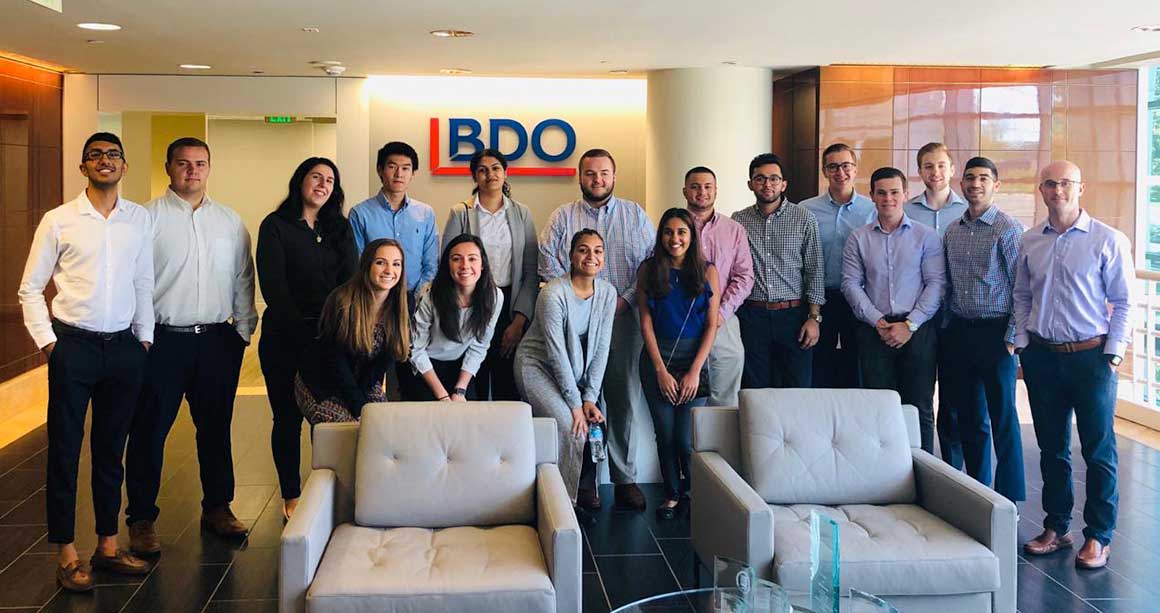
Image



As a student within Accounting at the Frank G. Zarb School of Business, you will be equipped with skills and knowledge to pursue a career in a technologically driven world of the future.
Our program is accredited by the AACSB, the world's largest business education alliance. We offer undergraduate, graduate, and dual-degree programs. View a sampling of our undergraduate accounting; and our accounting and taxation graduate courses.
Get involved in our active student organizations, which include Accounting Society, Beta Alpha Psi, and Tax Society. The groups meet on Wednesdays during Common Hour and hear from guest speakers from accounting firms and accounting roles within organizations. Take advantage of networking, volunteering, and social opportunities as a member of one of our student organizations.
Accounting is often called the language of business and serves as the foundation for many business decisions. For example, in advising young investors, Berkshire Hathaway CEO and billionaire Warren Buffett gave the following advice to young prospective investors, “You’ve got to understand accounting. You’ve got to. That’s got to be like a language to you.”
Accounting can help you with whatever career path you choose. Obtaining a degree in accounting from the Zarb School will provide you with the tools to understand and interpret accounting regulations and laws. Specifically, an accounting education at Hofstra will provide you with skills in cutting-edge technologies used in the profession, as well as subject matter expertise necessary to prepare and analyze financial statements, tax returns, and performance reports for companies, governments, not-for-profits, or even your own startup!
Career opportunities for those with an accounting degree can lead to various professional positions such as an auditor, tax accountant, forensic accountant, fraud examiner, FBI agent, financial analyst, consultant, compliance officer, chief financial officer, and chief executive officer. If you want to have your own business, you can start your own accounting firm. Whether you are just beginning your career or relaunching it, a degree in accounting from Hofstra will prepare you to excel in your chosen profession.
Our faculty members will prepare you for your career. They actively publish research in journals and books, present findings at national conferences and seminars, and receive recognition through awards for their contributions to the field of accounting.
Accounting can lead to various career paths such as:

Gain real-world experience working with professionals as an intern. On average, our undergraduate students have at least two internships and our graduate students complete at least one position during their course of study.
We help you find internships at top companies on Long Island, New York City, across the country, and around the world. We are supported by our strong alumni network, advisory board of top global business executives, and we encourage students to tap into resources here at Hofstra including our Career Center, and Graduate Business Career Services.
Our 120-credit Bachelor of Business Administration in Accounting prepares students to become accountants or to pursue careers in business or government. For students looking to graduate with a certification, our 150-credit CPA licensure track allows you to take additional courses in specialized accounting topics along with other electives. Learn more about our undergraduate accounting degree programs.
New York state currently requires a minimum of 150 semester hours of education in order to obtain CPA certification. We offer several programs that satisfy the requirement.*
*Requirements vary from state to state and are subject to change at any time. Students are advised to check with their individual state boards of accountancy for the most specific, up-to-date state educational and licensing requirements by visiting www.nasba.org.
We offer minors to support your education whether you are a business student or student looking to gain knowledge to support your focus.
We offer career certificate programs for college graduates holding baccalaureate degrees. Learn more
Complete both your undergraduate and graduate degrees through one of our five-year programs. Contact graduatebusiness@hofstra.edu for more information.
We offer several master’s degrees, MBA, and joint-degree programs.
We provide accountancy students with the knowledge and technological skills necessary to become successful professionals in a rapidly changing business environment. We strive to expose our students to current and emerging technologies to enable them to adapt to continuous technological developments to help them succeed in their careers. We strive to provide our students with various professional networking opportunities. We also strive for excellence in teaching and research, and encourage interaction with the community and business.
Chair
Chair and Chaykin Distinguished Professor in Accounting
Phone:
516-463-6987
Email:
jacqueline.a.burke@hofstra.edu
Office:
Room 228 Guthart Hall
Student Advisement
For Student Advisor, please contact ACCTTAX@hofstra.edu
