



UNDERGRADUATE PROGRAMS IN
Why Study Geology and Environmental Resources
Geology and environmental resources gives students a front-row seat to the forces that shape our planet and the skills to help protect it. Students study Earth’s history, processes, resources, and environmental challenges through hands-on exploration, fieldwork, and authentic research.
Hofstra students learn in the field. They’ve traced Darwin’s footsteps in the Galápagos, studied volcanic hazards in Greece, crossed Arizona’s deserts, and followed the path of a solar eclipse across five states. With access to diverse geological formations and natural systems in the New York region and beyond, students build real scientific expertise and prepare for careers in geoscience research, environmental consulting, resource management, climate resilience, earth science education, and more.
Read About Hofstra’s Galápagos Project Follow the Adventures in BelizeLearn by Digging In
Gain real scientific experience through field expeditions, hands-on research, and collaborative lab work.
Apply NowDegrees & Programs
Hofstra offers degree programs in geology (BA, BS) and environmental resources (BS), as well as minors in geology and meteorology. The program you choose comes down to whether you want to pursue a career as a research scientist, an environmental consultant, or use your degree to inform work in another field, such as science writing, education, engineering, environmental advocacy, or law and public policy.
Most students studying geology or environmental resources also take classes in sustainability, which encompass topics such as renewable energy, regenerative agriculture, waste management, and urban planning.
UNDERGRADUATE DEGREES & PROGRAMS
BS in Environmental Resources BS in Geology BA in Geology Minor in Geology Minor in MeteorologyCareer Paths & Outcomes
The demand for trained professionals in careers requiring a geology degree, such as environmental consulting, hydrology, mining, geotechnical consulting, or environmental management, is growing faster than the average for all other occupations over the next decade, according to the U.S. Bureau of Labor Statistics.
Hofstra’s geology and environmental resources graduates go on to work in a variety of public and private settings: university and museum research; environmental remediation, waste management, hydrology, mining, engineering, and construction industries; and environmental management (in both the government and nonprofit sectors). A geology degree from Hofstra is also great training for advanced studies, including geoscience, sustainability, law, medicine, and engineering. Geology students can also become certified to teach Earth Science in middle and high school.

Examples of institutions where Hofstra geology graduates are pursuing advanced degrees include:
- Bard College
- Brown University
- Columbia University
- Hofstra University
- Hunter College
- Pace University
- Syracuse University
- Texas A&M University
- University of California, Santa Cruz
- University of Georgia
90%
Geology and environmental studies graduates who were employed or in graduate school within a year after graduating
$59K
Average annual salary of graduates employed in the field
Where Learning Meets Discovery
Labs and Resources
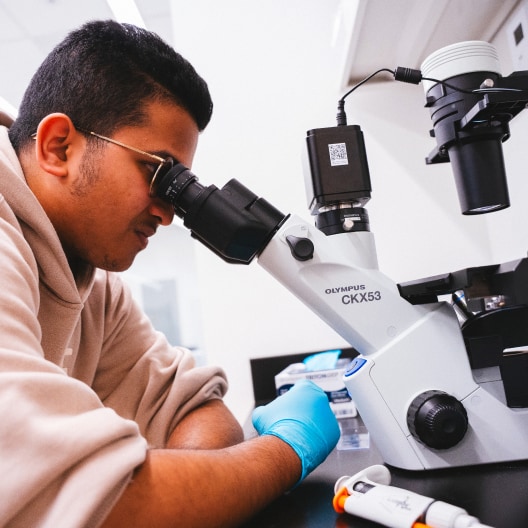
The Department of Geology, Environment, and Sustainability is located in Gittleson Hall, where students work in well-equipped laboratories for petrography, sedimentology, environmental geology, paleoclimatology, and paleontology. A supercomputer laboratory supports the analyses of large data sets and geographic information systems (GIS) projects.
Gittleson Hall is a designated Collaboratorium, a cutting-edge research and teaching space that includes labs, classrooms, and computer facilities shared by researchers across campus to encourage collaboration across disciplines on projects ranging from soil analysis of urban areas to bone replacement compounds. Collaboratorium instrumentation available to Geology and Environmental Resources students include a scanning electron microscope (SEM) with energy dispersive X-ray spectroscopy (EDS) and a portable X-ray fluorescence (pXRF) scanner.
Take a Tour of the Collaboratorium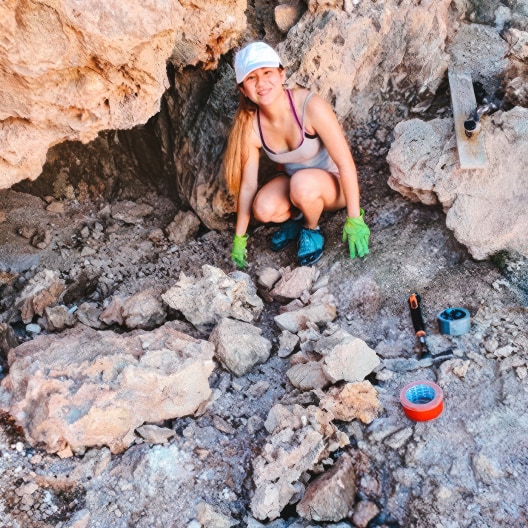
Off-Campus Research and Internships
Students are encouraged to pursue summer research at other universities and government labs, as well as internships that offer hands-on experience and course credit. Hofstra students have interned with environmental consultants such as Roux Associates and CA RICH Consultants, and with non-profit organizations and research institutions such as The Nature Conservancy, the National Park Service, U.S. Geological Survey, Lunar and Planetary Institute, Jet Propulsion Laboratory, Stanford University, American Museum of Natural History, and the Lamont-Doherty Earth Observatory at Columbia University.
Related Subjects
Contact Us
Office Information
Department of Geology Environment and Sustainability
Room 143 Gittleson Hall 114
Office hours:
Monday-Friday, 9 a.m.-4 p.m.