




UNDERGRADUATE PROGRAMS IN
Why Study Physics
At Hofstra, physics challenges you to understand how the universe works, from the behavior of galaxies to the properties of subatomic particles. You will take courses in mechanics, optics, electricity and magnetism, and modern physics before moving into advanced topics like quantum and statistical mechanics. Through lab work and research, you will gain hands-on experience and develop the analytical and technical skills valued across many fields. You can choose from a variety of degree options, add a minor in physics or astronomy, or combine physics with areas like mathematics, chemistry, or engineering to match your interests and career goals.
Discover New Momentum
Pair theory with hands-on research, internships, and lab work from your first year on campus.
Apply NowDegrees & Programs
You will explore the foundations of physics; the roles of hypotheses, measurement, and analysis; and the development of scientific theory through small classes and laboratories. Intermediate-level courses in modern physics, mechanics, optics, and electricity and magnetism will further prepare you for senior-level courses in quantum and statistical mechanics.
Hofstra offers three degree options in the Department of Physics, as well as minors in astronomy and physics. The department is also home to a graduate program in medical physics.
Physics may also serve as a hub for other disciplines, such as a double major with mathematics, chemistry, or engineering.
Explore physics undergraduate courses.
UNDERGRADUATE DEGREES & PROGRAMS
BS in Applied Physics BS in Physics BA in Physics Minor in Physics Minor in AstronomyUNDERGRADUATE Courses
PhysicsCareer Path & Outcomes
Students begin by exploring the foundation of physics before moving on to courses in modern physics, mechanics, optics, electricity and magnetism, quantum mechanics, and thermodynamics. Beginning in the sophomore or junior year, about half of our majors elect to participate in research programs or advanced projects continuously until graduation.
Your Future in Physics
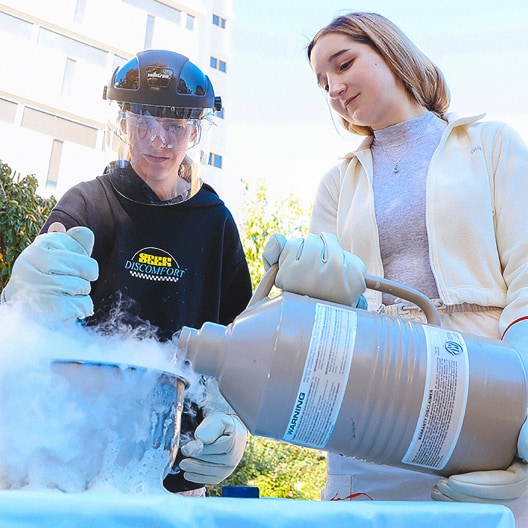
Follow Your Own Path
Students begin by exploring the foundation of physics before moving on to courses in modern physics, mechanics, optics, electricity and magnetism, quantum mechanics, and thermodynamics. Beginning in the sophomore or junior year, about half of the physics majors elect to participate in research programs or advanced projects continually until graduation.
Labs and Resources
Studying physics at Hofstra means that as early as your first year, you’ll have many opportunities to engage in long-term research projects with your professors and work in technologically advanced facilities, including the Low Temperature Condensed Matter Laboratory, Biophysics Research Laboratory, and Hofstra University Observatory with advanced CCD imaging. These labs investigate such practical applications as high-temperature superconductivity and advanced imaging of cell membranes.
The research groups in theoretical physics and astrophysics study phenomena ranging from supernova explosions to the exotic states of topological superconductors, which may be the platform for future quantum computers.
Internships
Internships and fellowships give students hands-on experience and help clarify career goals. Physics majors have interned at Brookhaven National Laboratory, Cornell University, Cradle of Aviation Museum, and New York and Atlantic Railway. Students also participate in Research Experiences for Undergraduates (REUs) nationwide and join Sigma Pi Sigma and Society of Physics Students to experience a strong, connected department community.
Related Subjects
Contact Us
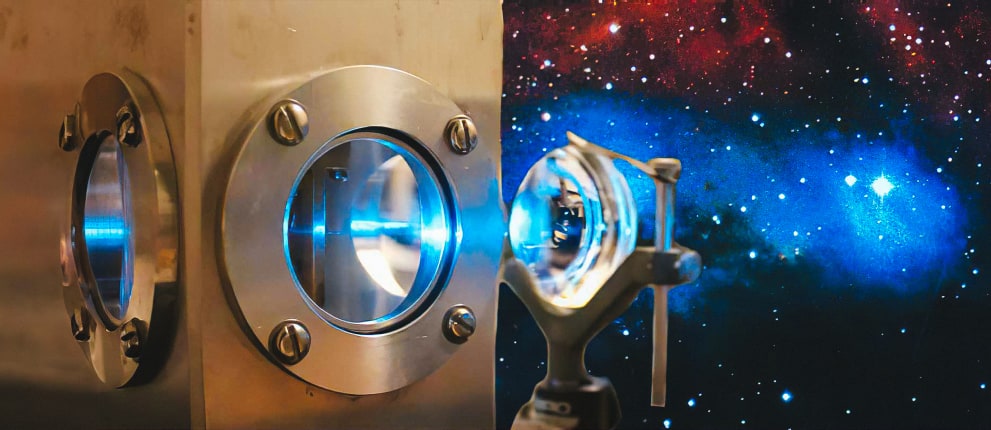
Explore physics at Hofstra through small classes, advanced labs, and faculty-led research that prepares you for graduate study and science-driven careers.