




PROVOST’S OFFICE
Fall 2026
Distinguished Faculty Lecture
Privacy in Pandemics:
The Science of Seeing Without Watching
presented by
Hafiz Asif, PhD
Assistant Professor of Information Systems and Business Analytics
Frank G. Zarb School of Business
Wednesday, October 14, 2026
1-2:15 p.m.
Guthart Cultural Center Theater, First Floor, Axinn Library
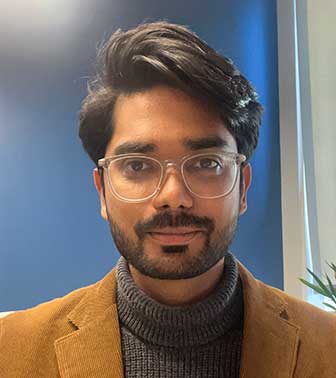
Your phone knows where you’ve been. Your apps know when you feel sick. In a pandemic, that data could save lives. But at what cost to privacy?
In this lecture, Dr. Hafiz Asif, Assistant Professor of Information Systems and Business Analytics, will present his research on differential privacy: a mathematical framework used by the U.S. Census Bureau, Apple, and Google to learn from populations without identifying individuals within them. The core idea is as elegant as a coin toss: deliberate randomness makes individuals mathematically invisible while preserving population-level patterns needed for public decisions. Drawing on COVID Nearby, a pandemic surveillance system he developed with an interdisciplinary team of epidemiologists, cryptographers, engineers, and human-computer interaction experts, Dr. Asif will show how this works in practice, what it took to build and deploy, and what it revealed about how people negotiate privacy in a crisis. He will also discuss how the same methods apply to data-driven decisions in healthcare, hiring, finance, and public policy.
This lecture is for anyone who works with data, is affected by it, or wants a say in how it shapes the world we share.
Dr. Hafiz Asif is an Assistant Professor in the Department of Information Systems and Business Analytics. His research develops safe and trustworthy AI systems, protecting privacy, ensuring fairness, and building accountability into the algorithms that increasingly shape our lives. Dr. Asif’s work has been recognized internationally. He is a winner of the U.S.–U.K. Privacy-Enhancing Technologies Prize Challenge, jointly sponsored by the White House and the UK government to advance the frontiers of privacy-preserving innovation. His research has been funded by the National Science Foundation and recognized with IEEE Best Paper Awards in both 2022 and 2024. It has appeared in leading journals spanning computer science, information systems, and operations research. At Hofstra, he brings these ideas into the classroom through courses in AI in Business, AI in Healthcare, and Responsible AI. He received his PhD from Rutgers University.
About the Distinguished Faculty Lecture
In 1981, the University inaugurated the annual Hofstra University Distinguished Faculty Lecture Series. The lecture is typically scheduled midsemester during Common Hour.
All full-time Hofstra faculty members who have not received the award in the four years prior to their application are eligible to apply. Note that while a lecture is the standard format, fine arts faculty may opt to have a performance or exhibit followed by a discussion. The lecture is the fruit of original thought and research on a topic both representative of the faculty member’s specialization and likely to attract and hold the interest of a wide, diverse audience. It is expected that this lecture will not have previously been delivered to the Hofstra community.
Calls for submission are sent out approximately six months prior to each lecture with specific application guidelines. We encourage your participation.
| Academic Year | Lecturer(s) |
|---|---|
| 1981-1982 | Mary Anne Raywid |
| 1981-1982 | Mary Anne Raywid |
| 1982-1983 | Frederick M. Keener |
| 1983-1984 | John DeWitt Gregory |
| 1984-1985 | Tadeusz K. Krauze |
| 1985-1986 | William F. Levantrosser |
| 1986-1987 | Charles F. Levinthal |
| 1987-1988 | W. Thomas MacCary |
| 1988-1989 | Dorothy Cohen |
| 1989-1990 | John E. Ullmann |
| 1990-1991 | Ignacio L. Götz |
| 1992-1993 | Eric M. Freedman |
| 1993-1994 | George D. Jackson |
| 1994-1995 | Lesley H. Browder, Jr. |
| 1995-1996 | Gary W. Grimes |
| 1996-1997 | Laurie Fendrich |
| 1997-1998 | Meena Bose |
| 1998-1999 | Stanislao G. Pugliese |
| 1999-2000 | Laura C. Otis |
| Fall 2000 | Charles Merguerian |
| Spring 2001 | Jacques D. Berlinerblau |
| Fall 2001 | Craig M. Rustici |
| Spring 2002 | Ronald H. Silverman |
| Fall 2002 | John L. Bryant |
| Spring 2003 | Richard J. Puerzer |
| Fall 2003 | Alan J. Singer |
| Spring 2004 | Joanna Grossman |
| Fall 2004 | Benita Sampedro |
| Spring 2005 | John Teehan |
| Fall 2005 | J. Herbie DiFonzo |
| Spring 2006 | Alafair Burke |
| Fall 2006 | I. Bennett Capers |
| Spring 2007 | Monroe H. Freedman |
| Fall 2007 | Julie E. Byrne |
| Fall 2008 | David Green |
| Spring 2009 | Meena Bose |
| Fall 2009 | Barbara Stark |
| Spring 2010 | Harold Hastings |
| Fall 2010 | Lisa M. Dresner |
| Fall 2011 | Elizabeth Glazer |
| Spring 2012 | Leslie Feldman |
| Fall 2012 | Vimala Pasupathi |
| Spring 2013 | Robert Brinkmann |
| Fall 2013 | Robert Leonard |
| Spring 2014 | Sina Rabbany |
| Fall 2014 | J. Herbie DiFonzo |
| Spring 2015 | No Lecture Held |
| Fall 2015 | Alafair Burke |
| Spring 2016 | John L. Bryant, Adam G. Sills, Vern R. Walker |
| Fall 2016 | David Henderson |
| Spring 2017 | Saryn R. Goldberg, Jennifer A. Gundlach, Amy M. Masnick, Jennifer A. Rich, Jessica R. Santangelo |
| Fall 2017 | Eric M. Freedman |
| Spring 2018 | Ethna Dempsey Lay |
| Fall 2018 | E. Christa Farmer, Elisabeth J. Ploran, Mary Anne Trasciatti |
| Spring 2019 | Linda A. Longmire |
| Fall 2019 | Shawn Thelen, Boonghee Yoo |
| Spring 2020 | Andrea S. Libresco (postponed; to be presented in spring 2021) |
| Fall 2021 | Simon R. Doubleday |
| Spring 2022 | Edward M. Segal |
| Fall 2022 | Javier A. Izquierdo |
| Spring 2023 | Gina Pontrelli, Christine Zammit |
| Fall 2023 | Ibraheem Karaye |
| Spring 2024 | Vicente Lledó-Guillem |
| Fall 2024 | Alan Singer, PhD |
| Spring 2025 | Ethna Lay, PhD |
| Fall 2025 | Eric M. Freedman, JD |
Hofstra’s academic programs empower you to think beyond the classroom and turn knowledge into action. Find the right program for your goals and shape your future with us.