Image
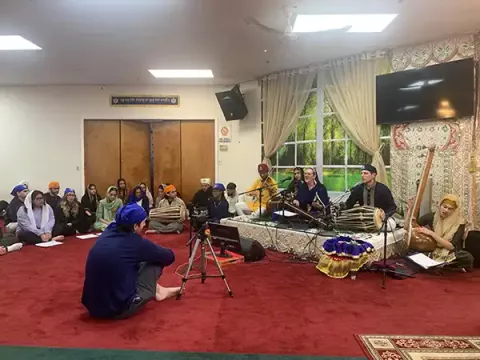


On March 20, 2025, for the Oxford Interfaith Forum, Prof. Francesca Cassio delivered a lecture titled “Attuning the Mind to the Divine: The Pluriversal Archive of Sikh Liturgical Songs."
Abstract: In heterodox traditions of pre-modern South Asia, singing and listening to sung poetry was a transversal way of engaging with spiritual knowledge. This system was incorporated and implemented in the early 16th century by the founder of the Sikh faith, Gurū Nānak (1469-1539), who established kīrtan (or the singing of liturgical hymns) as a core practice and an essential component of the Sikh listening habitus (Feld 2024; Becker 2004). According to Sikh thought, the divine Word emanating from a non-human force (the Sat Gurū) is the agent that attunes the mind of the disciple, operating a transformation from a self-willed individual (manmukh) into a Gurū-oriented person (gurmukh) (Mandair 2023). Since early Sikh history, the Word-as-Gurū was imparted in musical forms according to melodic frameworks called rāga-s that were functional to the transmission and embodiment of the Word. These rāga-based poetries constitute the main body of the Sikh canonical Scripture, the Srī Gurū Granth Sāhib. Organized according to 31 main ‘melodic’ chapters, the Scripture includes songs from six of the ten historical Sikh gurus, as well as devotional poetries attributed to Sufi and Bhakti saint-composers of the premodern era. While in the Srī Gurū Granth Sāhib, the Word has been transmitted in written form, for centuries, the musical setting of the verses has been passed on orally in heritage compositions that are credited as original from the Sikh gurūs’ times. The Sikh musical heritage is in danger of disappearing today, and preserving these compositions is critical to studying Sikhi(sm) as a pre-modern cultural system that envisioned and sustained an ecology of knowledges of the Global South (Santos 2014). Through a decolonial lens, this lecture discusses Sikh musical literature as a pluriversal archive of liturgical sung poetry of premodern South Asia, whose rāga-based renditions were not regarded as an art form but rather as an integral component of Sikh education.
On Vaisakhi 2025, the Sikh Musicology class led by Professor Francesca Cassio offered a kirtan. The sangat appreciated the students’ participation and the performance of traditional compositions (shabads) from the Sikh heritage repertoire.
Raag Rapsody: prof. Cassio’s Interview for Hofstra Radio
Interview for the Gur Nanak Interfaith Prize, Hofstra University
Guru Nanak Interfaith Prize, Hofstra University
On April 12, 2025, the Sikh Musicology class presented a performance of traditional Sikh compositions (shabads) to celebrate this year’s awardees. The event was graced by Mrs. Indie Singh (daughter of Dr. Hakam Singh), Provost Charlie Riordan, and President Susan Poser.

On October 20, 2024,
Prof. Francesca Cassio delivered the keynote speech for the International Kīrtan Conference held at the University of Patiala (India).
The title of the lecture is: “Repositioning Gurbānī Sangīt in the context of South Asian Musical Literature and Practices”.
On the occasion of Vaisakhi 2024, the Sikh Musicology class joined the Sikh community at the Mata Sahib Gurdwara in Glen Cove (NY) and performed a kirtan based on heritage compositions learned in class.
On February 18, 2023, Bhai Baldeep Singh - the 13th generation exponent of Gurbani Kirtan and scholar - visited the Sikh musicology class and offered an in-depth on the revival of the uncolonized Sikh heritage, touching upon the native pedagogical system, repertory and instruments.
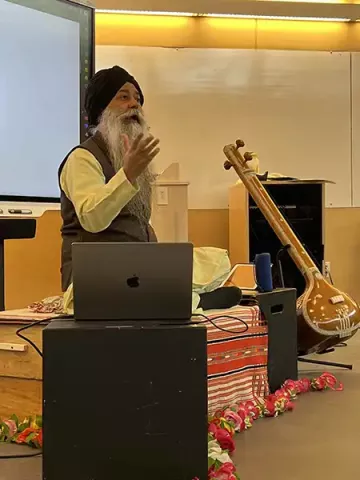
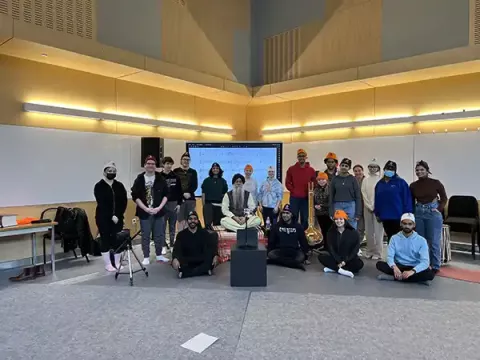
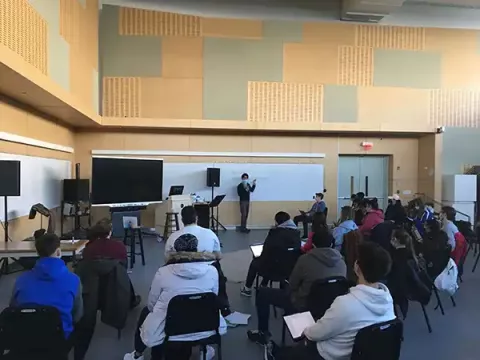
In the Spring of 2022, Prof. Balbinder Singh Bhogal, Chair of the Sikh Studies at Hofstra offered an enlightening lecture on Sovereignty in Sikh philosophy.
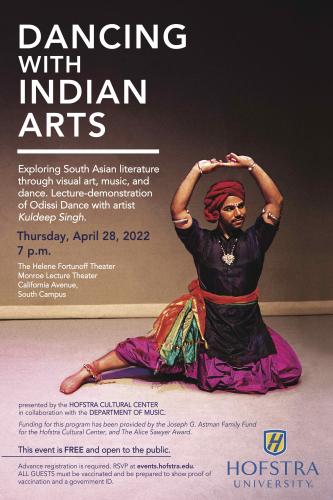
Visual and performance artist Kuldeep Singh brings an immersive interdisciplinary experience weaving Odissi dance with 18th century Indian miniatures, and early medieval texts on music and dramaturgy, which collectively celebrate and embody expressions of devotion. Mr. Singh will be accompanied on the Indian drum pakhawaj by Michael Shoureas.
Funding for this program has been provided by the Joseph G. Astman Family Fund for the Hofstra Cultural Center, and the Alice Sawyer Award and the Rabinowitz Honors College.
Date: Thursday, April 28, 2022
Time: 7:00 p.m.
Location: Fortunoff Theater, Monroe Lecture Center, California Avenue, South Campus
Free and open to the public. More Information
On October 21, 2021, for the ICTM series “Dialogues: Towards Decolonizing Music and Dance Studies”, Dr. Cassio presented an interdisciplinary panel discussing decolonial approaches to the study of Sikh musical heritage. The conference was then published as a video chapter: “The Necessity of a Decolonial Frame: Undoing the Inscriptions of Colonial Modernity in the Study of the Sikh Musical Heritage.” 2022. In Dialogues: Towards Decolonizing Music and Dance Studies. Edited by Tan Sooi Beng and Marcia Ostashewski. Scalar – University of South California: International Council for Traditional Music.
Open Access: https://scalar.usc.edu/works/ictm-dialogues/the-necessity-of-a-decolonial-frame?path=the-dialogues.
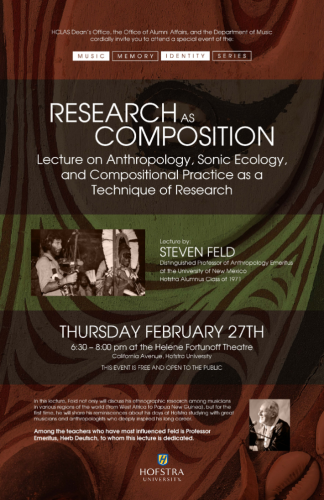
A special event of the Music, Memory and Identity Lecture Series, Directed by Dr. Francesca Cassio
Thursday, February 27, 2020, 6:30-8 p.m., The Helene Fortunoff Theater, Monroe Lecture Center
Professor Steven Feld is one of the most influential scholars in the field of Anthropology of Music. In this lecture, Professor Feld not only will discuss his ethnographic research among musicians in various regions of the world (from West Africa to Papua New Guinea), but for the first time, he will share his reminiscences about his days at Hofstra studying with great musicians and anthropologists who deeply inspired his long career. Among the teachers who have most influenced him is Professor Emeritus Herb Deutsch, to whom this lecture is dedicated.
Conference is presented in collaboration with Hofstra University’s Sardarni Kuljit Kaur Bindra Chair in Sikh Studies. Additional conference information is available on that website.
Friday, October 11- Saturday, October 12
9 a.m.-5 p.m., Leo A. Guthart Cultural Center Theater
Joan and Donald E. Axinn Library, First Floor
Thursday, October 10, 7:30-9 p.m.
Guru Nanak’s Musical Word sung from Sikh Sacred Scripture
The lyrical hymns of Guru Nanak (1469-1539), the founder of the Sikh tradition, are presented in this concert in their traditional form – as transmitted in the Gur-Sikh parampara – by renowned scholar and 13th generation kirtania Bhai Baldeep Singh accompanied on the dhrupadi rabab by Daud Khan Sadozai(India).
Introductions by Professor Balbinder Singh Bhogal, Department of Religion, and Professor Francesca Cassio, Department of Music.
Saint Kabir’s Musical Word sung from Sikh Sacred Scripture
The lyrical hymns of the bhakti saint Kabir (1440-1518) preserved in the Guru Granth Sahib, are presented in this concert according to the traditional style by the renowned head of the Kabir Panth Sri Prahlad Tipaniya (India).
Saint Farid’s Musical Word sung from Sikh Sacred Scripture
This concert showcases the poetry of the Sufi saint Sheikh Farid (1179-1266) preserved in the Guru Granth Sahib, performed according to the qawwali genre by Dhruv Sangari, (India), the last disciple of the legendary singer Nusrat Fateh Ali Khan.
Location for all three concerts: The Helene Fortunoff Theater, Monroe Lecture Center
California Avenue, South Campus
HOFSTRA UNIVERSITY, Hempstead, NY
All concerts are free and open to the public
For more information and registration visit hofstra.edu/sikhstudies
or email Sikhstudies@hofstra.edu
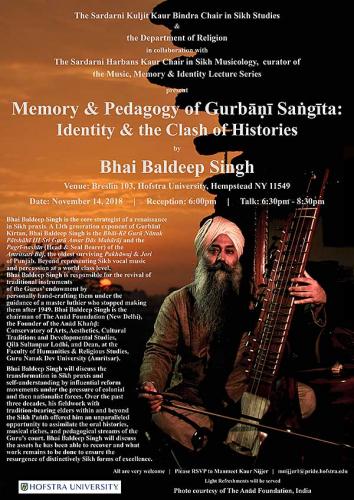
For the Hofstra lecture series on Music, Memory and Identity, the renowned musician and scholar Bhai Baldeep Singh will discuss the transformation in Sikh (musical) praxis and self-understanding by influential reform movements under the pressure of colonial and then nationalist forces. The talk touches upon the clash of oral and written accounts on the Sikh tradition, and the strategies to preserve its musical heritage in danger of disappearing. The event is organized by the Sardarni Kuljit Kaur Chair in Sikh Studies and the Department of Religion, in collaboration with the Sardarni Harbans Kaur Chair in Sikh Musicology.
The talk will be held at Breslin 103, from 6:30 to 8:30 p.m. Reception at 6 p.m.
Open and free to the public.
Thursday, November 3
Traditions in Transition: Intangible Cultural Heritage in South and Southeast Asia Symposium
This symposium unites scholars from the disciplines of anthropology, ethnomusicology, folklore, theater and Asian studies to sacred traditions of South and Southeast Asia. Through the participation in workshops given by scholar-practitioners, performances of a central Javanese Gamelan orchestra, Sundanese rod puppetry theater, Sikh religious hymns, academic lectures, and a one-day installation of an exhibit of puppets, costumes, instruments, and ethnographic photos of healing performances, participants in this symposium gain insight into complex performance forms and explore the paradoxical issues currently facing the traditional arts and their definition as intangible cultural heritage in South and Southeast Asia. UNESCO defines intangible cultural heritage as "the practices, representations, expressions, knowledge, skills — as well as the instruments, objects, artifacts and cultural spaces associated therewith — that communities, groups and, in some cases, individuals recognize as part of their cultural heritage." More Information
Francesca Cassio, the Sardani Harbans Kaur Chair in Sikh Musicology at Hofstra University will be participating in the following events around the country:
Thursday and Friday, February 26-27
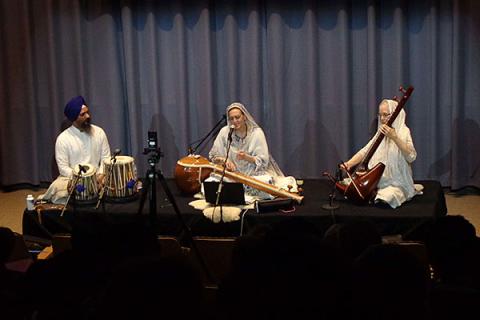
Dr. Cassio will perform with Parminder Singh Bhamra and Nirvair Kaur Khalsa and present a paper, "The Sonic Pilgrimage: Gurbani Kirtan as Vehicle of the Spiritual Journey” at the Music and Poetics of Devotion in the Jain and Sikh Traditions conference at Loyola Marymount University, Los Angeles, February 26-27. More information
Friday-Sunday, March 4-6
She will participate in a conference on the Music of South, Central, and West Asia at Harvard University. Dr. Cassio will perform on March 4 with Parminder Singh Bhamra and Nirvair Kaur Khalsa and deliver the pre-concert lecture, “Singing at the Guru’s court. The dhrupad of the Gurbani kirtan tradition.” More information
Thursday, April 7
Dr. Cassio will serve on a panel, “Women and Music in Religious Traditions from Around the World,” with a focus on the case study of Female Singers of Sikh Kirtan for the music conference Spirit and Sound, organized by the Institute for Religion, Culture and Public Life at Columbia University. She and Parminder Singh Bhamra and Nirvair Kaur Khalsa will also perform at the S. James Chapel (Union Theological Seminary) at 121 St. and Broadway, New York. More information
Monday, November 17, 7 p.m.
Sacred and Secular in the Sikh Musical Tradition by Dr. Virinder Kalra, University of Manchester (UK)
This event is sponsored by the Hofstra Cultural Center in collaboration with the Sardarni Harbans Kaur Chair in Sikh Musicology.
Since the traumatic events of 1984 many aspects of Sikh cultural life have come under scrutiny and to some extent revival and reform, parallel with the Singh Sabha movements of the early 20th century. Sikh kirtan has also been subject to these revivalist forms resulting in a number of attempts at bringing tunes, instruments and practices back into use that had fallen into abeyance. This renaissance has been well documented and also received some academic attention. However, the vast majority of Sikh kirtan that continues to be produced and performed is of a popular variety. By focusing on the experiences of kirtan performers and the institutional structures in which music is managed in Gurdwaras, this talk will offer some reasons for the continuing salience of popular kirtan.
The Hofstra Cultural Center presents the Joseph G. Astman Concert Series Sacred Music from Around the World
Thursday, March 13, 7:30 p.m.
Persian Mystic Songs for Nowruz
Sepideh Raissadat, vocal and sehtar; Naghmeh Farahmand, zarb, daff
The event celebrates the Nowruz, the festivity marking the Iranian New Year on March 21.
In collaboration with D'Addario Music Appreciation Initiative.
Admission: Fee
Wednesday, April 9, 7:30 p.m.
The Words of My Beloved. Holy Hymns from the Sikh Gurus'tradition
Dr. Francesca Cassio, vocal and tanpura Parminder Singh Bhamra, pakhawaj; Nirvair Kaur Khalsa, taus
Dr. Francesca Cassio (Sardarni Harbans Kaur Chair in Sikh Musicology at Hofstra University) will perform traditional hymns from the Sikh Gurus' repertoire (late 15th-early 18th century) in the medieval dhrupad style.
Admission: Free
Wednesday, April 16, 7:30 p.m.
The Alash Ensemble Performing Overtone Singing from Tuva
Ayan-ool Sam, Bady-Dorzhu Ondar and Ayan Shirizhik
The Alash Ensemble is a trio of master overtone singers (xöömei) from Tuva, a tiny republic in the heart of Central Asia.
Admission: Fee
Location for all 2014 events:
The Helene Fortunoff Theater, Monroe Lecture Center, California Avenue, South Campus
In the month of April 2014, the percussionist Parminder Singh Bhamra (Anad Conservatory, Sultanpur Lodhi) will teach pakhawaj classes to the Sikh Musicology students.
If you wish to attend the classes, please write to: Francesca Cassio
Spring 2013
Friday, April 12, 2013, 5 p.m.
Hymns from the Sikh Music Tradition
North India, 15th-18th Century
The First Sardarni Harbans Kaur Chair Student Recital
Featuring
Jessie Ann Bolash, Vocal and Tānpūrā
Rikhav Kothari, Pakhāwaj
Special Guest
Michael Braudy, violin
The Helene Fortunoff Theater
Monroe Lecture Center, South Campus
On July 15, the Sardarni Harbans Kaur Chair in Sikh Musicology, in association with The Hemkunt Foundation and the ANAD Foundation organized a lecture on “Authentic stringed instruments used in the Gurbani tradition” by Bhai Baldeep Singh.
Bhai Baldeep Singh descends from a long tradition of masters of the Gurbani Kirtan, and today is its thirteenth-generation exponent. His repertoire includes masterpieces that were originally composed by the Sikh Gurus and the Bhagats. Bhai Baldeep Singh is also the prime exponent (khalifa) of the oldest school (gharana) of classical percussion, pakhawaj/mridang playing, of Punjab known as Sultanpur Lodhi-Amritsari Baaj. Since 1987, with his research in the field he brought about the revival of musical instruments used in Gur-Sikh and Bhakti traditions by handcrafting these once-extinct instruments back to life.
In April 2012 the Sardarni Harbans Kaur Chair in Sikh Musicology invited for a visiting scholarship of a month the percussionist Parminder Singh Bhamra, currently assistant professor at Anād Conservatory (Sultan Lodhi, Punjab).
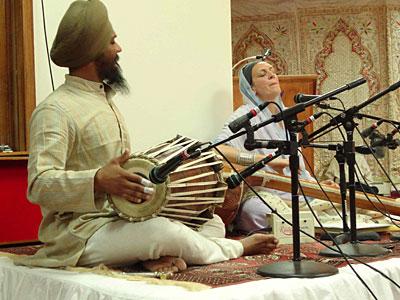
During his visit Parminder Singh Bhamra gave fourkīrtan-s (April 14, 18, and two performances on April 29), a workshop on pakhawāj (April 20, 27, May 4 ), eight classes, accompanying Dr. Cassio’s lectures in Sikh Musicology, and a radio interview on Hofstra University’s radio station, WHRU, (on April 30, 2012).
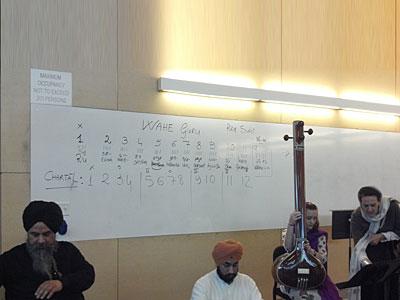
In his classes Mr. Bhamra instructed students to play pakhāwaj, and taught the following tāls: Tīvrā,Talwarā, Sultāl, Chartāl, Adha Chautāl , Tīn tāl
A performance of shabad kīrtan by Dr. Francesca Cassio.
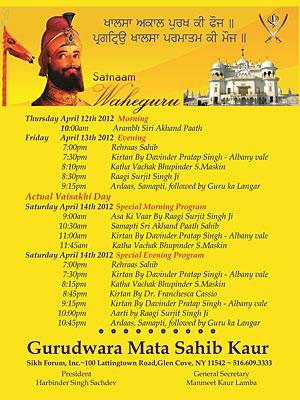
In the spring 2012 Dr. Cassio was invited to perform a kīrtan at the Gurudwara Mata Sahib Kaur in Glen Cove, Long Island, to celebrate the Sikh Vaisakhi Festival. The event was attended by a large audience from the Sikh Community of New York and Long Island.
On this special occasion Dr. Cassio performed Sikh traditional repertoire, in the authentic medieval dhrupad style, playing tānpurā, and accompanied on pakhāwaj by the renowned percussionist Parminder Singh Bhamra from New Delhi. The duo performed Rāg Bihagra in Pancham Sawari, Rāg Jaijawanti in Chartāl, Sri Rāg in Sultāl
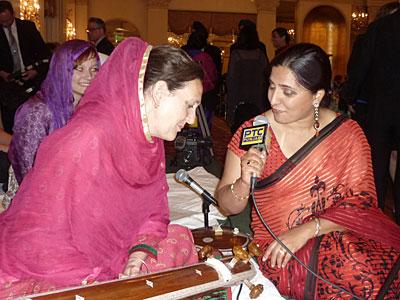
The class of Sikh Musicology led by Dr Cassio performed a short kīrtan recital at the Guru Nanak Interfaith Prize, an event organized by Hofstra University in collaboration with the Sardarni Kuljit Kaur Bindra Charitable Foundation.
The function was held at Garden City Hotel in Garden City, NY, and was attended by hundreds of guests, among them the Hofstra President Stuart Rabinowitz, the Provost and Senior Vice President of Academic Affairs Herman A. Berliner, Dean of Hofstra College of Liberal Arts and Sciences Bernard Firestone, Mr. Teji Bindra, Mrs. Indie Singh, Dr IJ Singh, Dr Eboo Patel, and Dr Balbinder Singh Bhogal.
Seven students accompanied the performance of Dr. Francesca Cassio and Parminder Singh Bhamra.
The class of Sikh Musicology led by Dr Francesca Cassio performed a recital of traditional Sikh Gurus’ repertoire in the medieval dhrupad style, with the accompaniment of Parminder Singh Bhamra on pakhāwaj. The class performed Rāg āsā, ālāp and a shabad in partāl (12 and 14 beats). The event was attended and highly appreciated by Hofstra students and faculty.
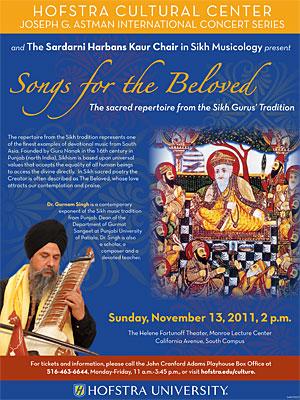
The Sardarni Harbans Kaur Chair in Sikh Musicology invited Dr. Gurnam Singh Rathour from the Punjabi University of Patiala (India) for a one-month visiting scholarship. During his visit, Dr. Gurnam Singh Rathour gave a recital of Gurbānī Sangīt, accompanied by Manpreet Singh (harmonium), Amandeep Singh (dilruba) and Bhai Raghbir Singh (tablā).
The event was held at the Helene Fortunoff Theater, in collaboration with the Hofstra Cultural Center and the Joseph G. Hastman International Concert Series.
Members of the Sikh Community as well as Hofstra students and teachers attended the event. Among the honorable guests: Dr. Hakam Singh with his daughter Mrs. Indie Singh, Dr. IJ Singh, Mr. Teji Bindra, Dr. Balbinder Singh Bhogal (Chair in Sikh Studies), Dr. Firestone (HCLAS Dean), Dr. Robinson (Chair of the Music Department)
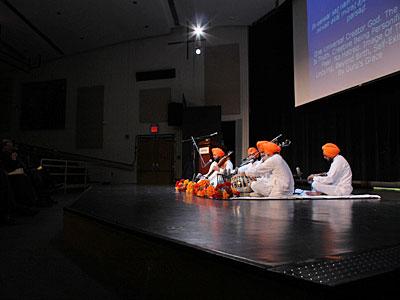
Dr. Gurnam Singh and his group performing at the Helene Fortunoff Theater, November 2011.
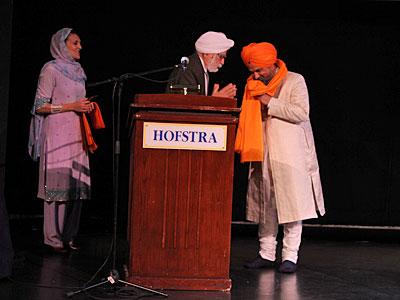
Dr Hakam Singh and Dr. Francesca Cassio felicitating Dr. Gurnam Singh Rathour after his performance at Hofstra University
In November 2011 Dr. Gurnam Singh Rathour was invited for a visiting scholarship on vocal music. Dr. Gurnam Singh is professor and founder Head of the Department of Gurmat Sangīt and Gurmat Sangīt Chair at Punjabi University of Patiala (India).
During his visit Dr. Gurnam Singh Rathour gave a concert (on November 13), two public lectures (November 8 and 22), a class for the Hofstra string orchestra (November 30) and four classes of vocal music for the students of the Sikh Musicology course
During his classes he taught rāg āsā and rāg suhī, with the accompaniment of harmonium, taus and tablā. The shabads he taught were his original compositions set on tāl keherwā and ektāl.
Parminder Singh Bhamra during a workshop at Hofstra University, Spring 2012